Winemaking: The Art of Patience & Timing
Balancing what our clients tell us, what we sense, and what has yet to reveal itself.

written by
Jay Hunsberger
I’d love to show you the view from my office window: rolling hills, often cloaked in fog pouring in from the Pacific Ocean, dotted with vineyards.
Sonoma County is a special place. There are small towns where people recognize you and greet you with a warm “hello.”
It has a vibrant agrarian culture and an appreciation for local artisans. It’s a place deeply connected to wine.
When I arrived here, fresh off of my classical music career, I dipped my toe into the wine industry – and what a smart decision that was! I had the good fortune to work for a small, family-owned winery that makes some of the best wine in the region – and that’s saying a lot since there are over 1,000 wineries in Sonoma and adjacent Napa Counties.
My boss was Csaba Szakál, who immigrated to the US from Hungary, where his grandparents made wine on their farm. Csaba fell in love with Sandy, a Sonoma native, and, soon after, they said goodbye to their successful corporate jobs to pursue their shared passion for making wine. I loved every minute of my work with Csaba and Sandy, including the long harvest days that started before dawn on a mountainside vineyard and ended with me cleaning out the inside of a giant wine press, covered in grape skins and juice, and looking like a happy Oompa-Loompa.
Csaba is truly an artist; his approach to winemaking (and life) closely mirrors most of the creators I know, in particular the composers who I had worked closely with for decades. He’s often lost in his big dreams and intuitively knows how to finesse the winemaking process to produce excellent results. As I would describe his wine – and the creative process that went into making it – to winery guests, I would often compare it to a great piece of classical music. Long after it was created it was being appreciated by an audience.
The Art of Winemaking: Perfect Timing
Winemaking is very much a long-term proposition. Think about it: if you’re savoring a glass of one of Csaba’s award-winning Napa Cabs, it may be nearly 20 years old. That doesn’t take into account many other details, like the fact that those grapes may have come from vines that someone planted 50 years ago. Imagine the patience it takes to steward that process from start to finish. Imagine all the decisions the winemaker faces along that journey. Consider how attuned he must be to all of the components that are involved at every step. It’s mind-boggling.
I was fascinated by his ability to create, with an eye many years ahead on a perfect outcome. “To be honest, patience is a tough one for me,” Csaba told me. “I’m always focused on the end goal, so waiting for the right moment doesn't come easy. While it’s tempting to rush and get things checked off early, holding off is usually worth it for the sake of quality. That said, it’s a fine line - you don't want to wait so long that you miss the boat entirely. It really comes down to finding that balance and being ready to move when the timing is right.”
My buddy Jon Jones, another masterful-yet-humble winemaker, was on track to be a professional trombone player when he heard the siren song of the vineyard calling him. I asked how he approaches the nuanced dance of winemaking:
“Most people believe the primary senses used [in winemaking] are taste and smell, but winemaking does really capture it all, including listening. There is the physical element of listening: a subtle bubbling with the start of fermentation to a sudden roar as the fermentation is at its peak. Incorporating listening with feeling temperatures and watching the activity can tell you how happy a fermentation is or if it may be struggling a bit. There is also the element of ‘listening to your instincts.’ These fermentations and the process - and even the bottled wine - is all alive. Which is really amazing! It’s a living organism that we care for, so it is vital to trust your feelings about how it is doing. Listening to your gut can pave the way for new paths forward in winemaking by trusting all of your senses at the same time, in real time.”
So many variables. So many opportunities to take in information and make decisions. Balancing a plan and real-time information.
Finding The Perfect Blend
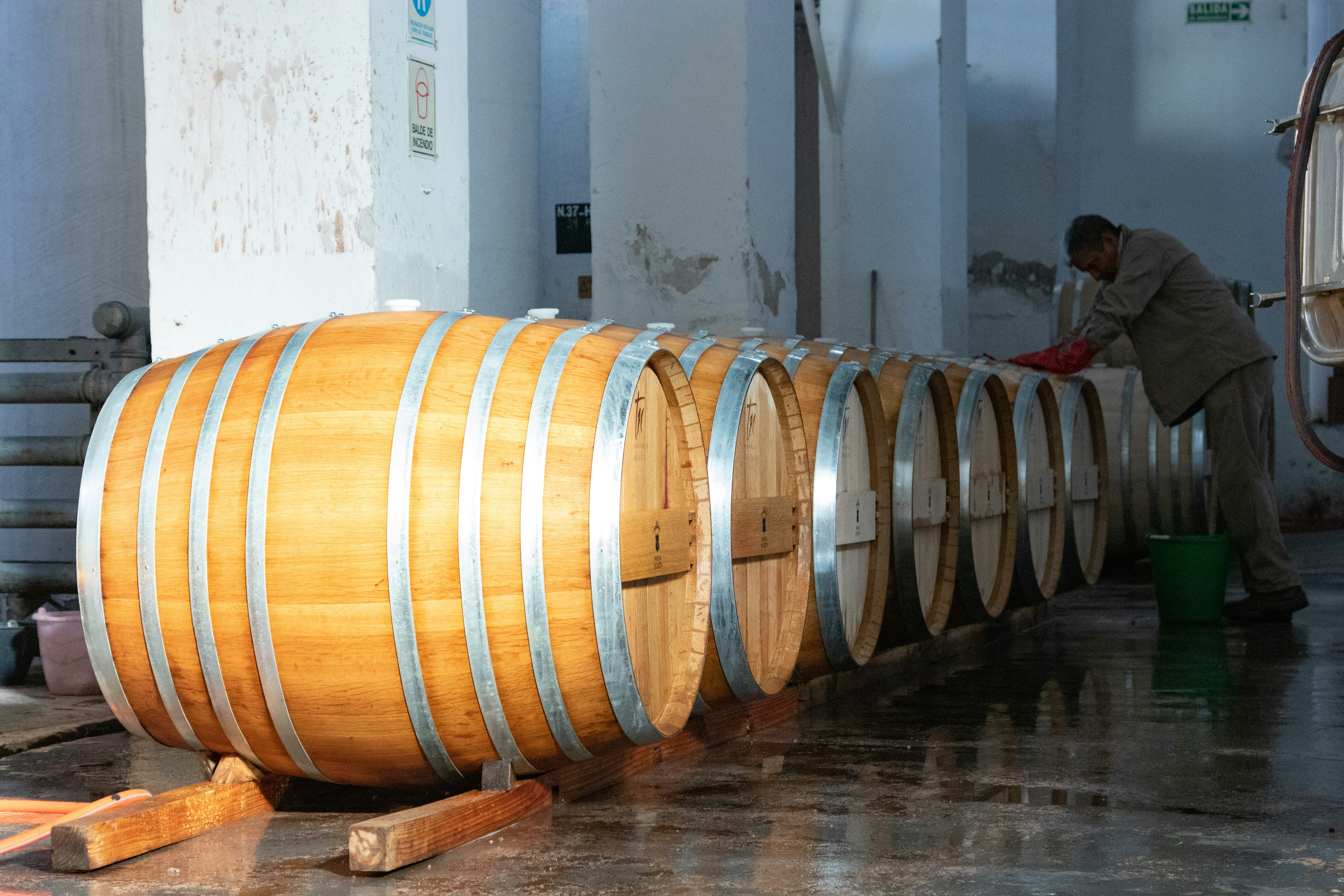
I remember one day in the wine cellar with Csaba. He was facing a complex question: which barrels would go into each of his finished wines. Unlike a large producer, Csaba had between 4 and 8 barrels that he was working with, which means there is no room for error. He and Sandy had spent months – starting back when the grapes were still on the vine – thinking through their options and figuring out exactly the right proportions. It’s a lot about strategy, knowing what worked well in the past, and years of experience that brings deep expertise. But it’s also about listening carefully to what’s right in front of you. Being open to possibility and taking a new path. I asked him, “What are you going to do?” He responded, “I don’t know yet. The wine hasn’t told me.”
Patience isn’t stubbornly sticking to the original plan. Sometimes listening tells you it’s time to go in a new direction.
Balancing Knowledge With Instinct
In the world of wealth planning, we're conditioned to reward visible progress. Gather the information. Build the model. Develop the alternatives. Make the recommendation. Decide. Implement.
All necessary. But the process can subtly create its own momentum. Eventually, finishing the plan can become more important than discovering the right plan.
There are things we know at the outset. Things we can analyze.
There are also things our clients are telling us. Things we're sensing but can't quite substantiate yet. And things that simply haven't revealed themselves.
Good planning requires, as Csaba might put it, knowing how to find the balance between waiting and acting. When I’m asked to give advice, the first thing I do is listen.
I listen to:
what clients say - including the words they choose and what they repeatedly return to;
what clients don't say - hesitation, discomfort, contradictions, subjects that somehow remain unresolved;
the evidence - what the numbers and circumstances are actually telling us rather than what we hoped they'd say;
my instincts - not as a substitute for analysis, but as a signal that something deserves another look;
time itself - because sometimes another conversation changes what we know.
The first decisions a client faces when seeking advice can often be framed analytically: What should I do? What is the financially optimal choice? What are my alternatives?
But the subsequent questions often ask something more personal and consequential. How can I engage my wealth to do something I never dreamed of? If I could really make a difference in this world, what would I do?
That's where rushing the process can be dangerous.
An adviser who is too eager to produce "the answer" can interrupt that process.
The winemaker doesn't make the wine mature by demanding that it mature faster. And an adviser can't manufacture conviction for a client simply because the analysis is finished.
The plan may be ready before the person is ready.
And that doesn't necessarily mean the planning process has stalled. It may mean the most important part of it is still happening.
Certainly, there are moments when delay is avoidance. Markets move. Opportunities disappear. Tax and estate-planning windows close.
So, the lesson isn't simply "wait."
It's: Don't confuse movement with progress, or patience with inaction.
The accomplished winemaker has learned when intervention is required and when intervention would actually diminish the result. That's the expertise.
The Wisdom of Wine
My task, as I shared Csaba’s delicious wine with guests at the winery, was not to convince them to like the Pinot Noir or Cabernet in their glass, any more than I could have convinced an audience to love Mozart or Mahler when I was a performing artist. What I could do was give them context, deepen their understanding of all that went into making the wine, and offer a historical perspective. And, usually, that was all it took.
One of the things I love about Csaba and Sandy’s approach is they don’t put flowery, complex tasting notes in front of their guests. They don’t want people focusing on what they are supposed to be tasting. They’d prefer the guest finds their own path. Sure, there is some measurable data – alcohol content, sugar levels, and more – that you could share. But those aren’t the things that are truly important, are they? It’s really about what you are experiencing, ideally with a little context and knowledge.
My role as an advisor is never about leading someone to a conclusion. It is about examining the facts and data, and then listening. What is really going on? What is the bigger picture?
Exploring. Listening. Balancing patience with action.
Patience & Timing: By The Numbers
Several reports from The Bridgespan Group reveal that transformational gifts usually come after patient stewardship, not at first sight. Bridgespan studied 165 social-change grants of $10 million or more and found that recipients had received a median of four prior grants from the same donor before this significantly larger gift. That suggests major impact often grows out of years of learning, trust-building, and smaller investments—not a single transaction. – Making Big Bets for Social Change, Winter 2016; Becoming Big Bettable, April, 2019.
MacKenzie Scott shocked the philanthropic and nonprofit worlds with the announcement that she had given $1.7 billion to 116 nonprofit organizations in July 2020, at a time when many nonprofits were reeling from the impacts of and increased needs created by the COVID-19 pandemic. Her gifts were made with few restrictions and no limits on when they must be used. A particularly remarkable example of responding quickly to needs that – a short time prior – would have seemed unthinkable. – The Center for Effective Philanthropy: Giving Big: The Impact of Large, Unrestricted Gifts on NonProfits, 2022.

