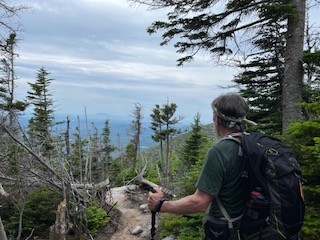
Hiking Maine’s Mount Katahdin
Having a map AND staying flexible.

written by
Jay Hunsberger
In the summer of 2025, two of my brothers, Peter and Ben, asked me to join them on their trip to hike Maine’s Mount Katahdin, the northern terminus of the Appalachian Trail.
They had done months of deliberate research and their plan was to take the Abol trail going up and coming down the mountain.
The Abol is the most direct way to the summit, but also the most strenuous, with some significant, large boulder scrambling near the peak.
Both fit and active, Ben and Peter have been avid hikers for decades. I had recently discovered their same joy and passion for it and was thrilled to join them.
The evening before the hike, we settled into our lakeside lodge and made final tweaks to our already well-equipped backpacks. The next morning we were up before the sun was – in Maine during the summer that means really early. The forecast was for late afternoon thunderstorms, so we drove into Baxter State Park as the gate opened. After the mandatory check-in at the ranger station, off we went up the Abol.
Up We Go!
The first hour or so was spectacular as we began to get some long-range vistas out to distant peaks. A few hours later, as we arrived at the boulders, the wind was picking up and, eventually, bands of clouds were whipping around us. At first this was amusing. But Mother Nature was clearly on a long, slow crescendo that quickly started to feel a little ominous. When we finished the boulders, as well as the majority of the steep incline, we couldn’t see more than 20 feet in front of us. The clouds had socked in the summit, the wind was blowing fiercely, and we were getting pelted by rain. We still had another half mile to go to the actual summit – where you’d want to take your photo with the official summit sign. Though we had given up hope of spectacular views, we hurried onward.
We found the sign and, in spite of the increasing rain and now gale force winds, we gulped down some lunch. We started talking about the trek back. None of us loved the idea of scrambling down the now rain-slick boulders. So, we considered taking the longer, but presumably less steep Hunt trail down. Ben had done the Hunt twenty years before but he couldn’t recall how challenging it was. A few fellow hikers who were huddled nearby had all come up that way. But none of them were going down the Hunt – they were all going down the Abol, our exhausting path up.
Best Laid Plans
We were wrapped in every layer we had brought with us, but still the wind-driven water found its way to our chilly skin. My mind was starting to race. I looked at my brothers and said that I’d much prefer the devil I knew – the Abol - to the one I didn’t – the Hunt. Peter pushed back saying he wasn’t sure he was physically capable of scrambling down the large boulders of the Abol. I understood that and felt the same way. There was no obvious, good choice.
Oh! Did I mention that two people died on this mountain a month before? Over 60 deaths have been documented on Katahdin since 1933. We all knew this was serious stuff.
We finished lunch and started back the half mile stretch to the edge, where we knew we’d have to choose our trail down. The tension and stress were building. Later, each of us shared that we were thinking “What foolish thing have I done?" Were we going to meet our fate here in the remote Maine wilderness?
As we approached our crossroads, a figure emerged from the dense, swirling fog: a young Argentinian guy who was solo hiking up the Hunt trail. He was panic-stricken and practically dropped to his knees when he saw us. His terror did nothing to help our moods, but somehow we managed to calm him down. Until we told him that we were thinking of taking the Hunt trail down. He then proceeded to beg us not to go that way under any circumstances (at this point he really did drop to his knees)! Yes, the Hunt was maybe less steep than our trail up, but, according to him, in a few places, if you made a wrong move, the drop would be disastrous.
I looked at my brothers and said “Guys, I feel like the universe is really trying to send us a message. I know it’s going to be challenging, but I really think we should go down the way we came up, the way we know.” After a few seconds, they agreed. Off we went down the boulders, now with our newfound friend to accompany us.
Unlike the three of us, though he was still pretty shaken up, he was in his early 20’s, which gave him an energy level and a youthful self-confidence we lacked. It was the perfect recipe. He’d bound ahead to the next mark and wait for us to catch up – a method we used for the next hour or so as we groped our way through the rain and gusts of wind.
By the time we were halfway down our descent, the weather started clearing and, after stopping to regroup and recharge, the final few hours were amazingly peaceful. As we walked and talked, I found myself so grateful that my brothers and I were able to maintain a level of clear-headed thinking and trust in each other as things were getting increasingly crazy at the top. The “gift” of the somewhat mysterious stranger felt almost too good to be true (and I suspect he felt the same). The feeling of accomplishment – of literally climbing a mountain in adverse conditions – stayed with us for a long time. But the deeper sense of having conquered some inner demons was the ultimate reward.
It struck me later that this wasn’t really just a story about hiking and tackling life’s challenges.
It was about stewardship.
We often imagine that the most important decisions are the ones we make before we begin. In reality, the decisions that shape the journey are the ones we never expected to face.
That’s true on a mountain.
It’s true in families. It’s true in philanthropy. And it’s certainly true after a life-changing liquidity event.
We call that moment the Second Decision - not because it’s chronologically second, but because it’s the point where planning gives way to judgment, and where having experienced companions matters more than having a perfect map.
On the trail, we discovered that our original plan wasn’t the most important thing. The important thing was having people beside us who could read the terrain, challenge assumptions, adapt quickly, and keep moving toward what mattered most.
Wealth has a way of creating the same kind of landscape.
The map gets you started.
But the journey is shaped by the decisions you make after the unexpected arrives.

